
1. Gabatarwa
This manual provides detailed instructions for the installation, operation, and maintenance of the PowMr 80A Solar Charge Controller. This device is designed to manage power flow from solar panels to batteries, ensuring efficient and safe charging for various battery types and system voltage.
Fim na 1.1: Unboxing the PowMr PStar Series Solar Controller. This video demonstrates the contents of the product package, including the controller and user manual.
2. Umarnin Tsaro
- Ensure all wiring is correctly polarized and securely connected to prevent damage to the controller or battery.
- Always connect the battery to the charge controller first, then the solar panel. Disconnect in the reverse order.
- Sanya na'urar sarrafawa a wuri mai iska mai kyau, nesa da kayan da za su iya kama da wuta da kuma hasken rana kai tsaye.
- Kada ka yi ƙoƙarin wargaza ko gyara na'urar sarrafawa da kanka. Tuntuɓi ma'aikatan da suka cancanta don yin aiki.
- Use appropriate circuit breakers or fuses for all connections to protect against overcurrent.
3. Samfurin Ya Ƙareview
The PowMr 80A Solar Charge Controller features an adjustable LCD display, dual USB outputs, and supports multiple battery types. It utilizes 3-stage intelligent PWM technology for efficient charging.

Hoto na 3.1: Gaba view of the PowMr 80A Solar Charge Controller, highlighting key technical specifications such as Max. PV Open Circuit Voltage (100V), Rated Charging Current (80A), Nominal System Voltage (12V/24V/36V/48V Auto), Charging Technology (PWM), Charge Algorithm (3-Stages), USB Interface (5V/2A*2), Net weight (0.75 kg), and Operating Temperature Range (-20°C ~ +55°C).
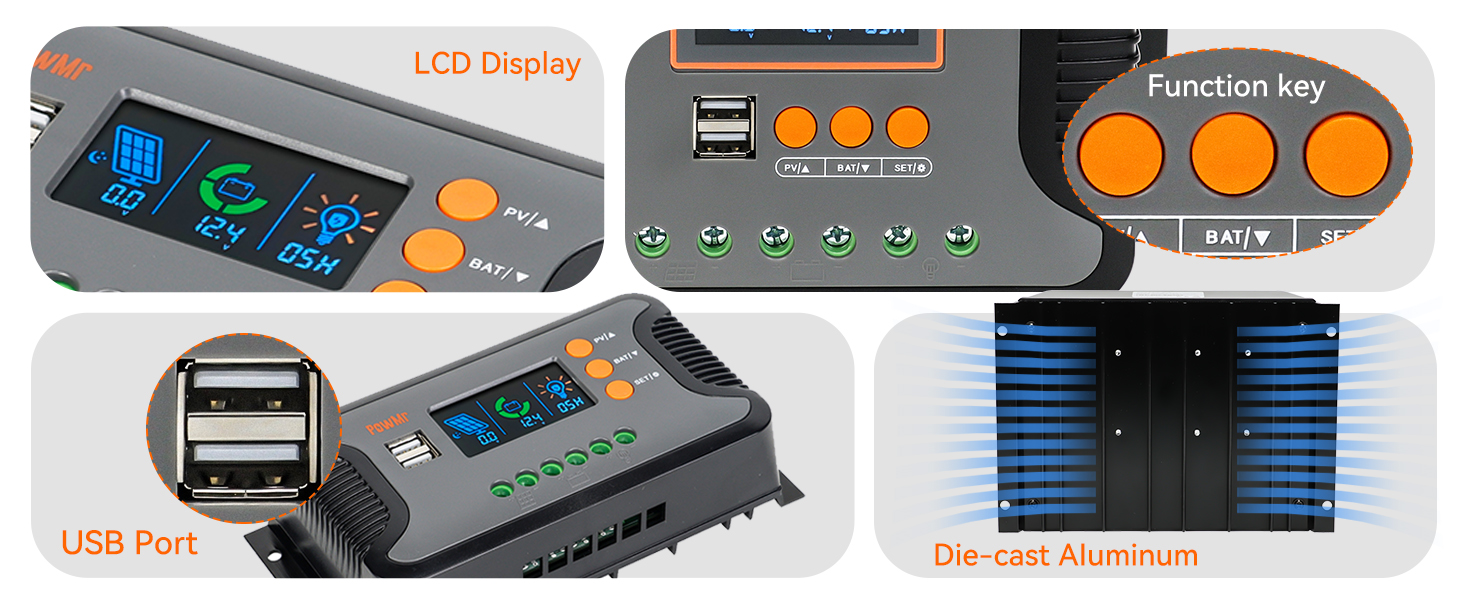
Hoto na 3.2: Dalla-dalla views of the controller's features, including the LCD display for monitoring, function keys for settings, dual USB ports for charging external devices, and the die-cast aluminum construction for heat dissipation.
3.1 Maɓalli Maɓalli
- Auto System Voltage Ganewa: Automatically detects 12V, 24V, 36V, and 48V DC systems.
- Babban Shigarwar PV: Supports a maximum PV input open circuit voltagda 100V.
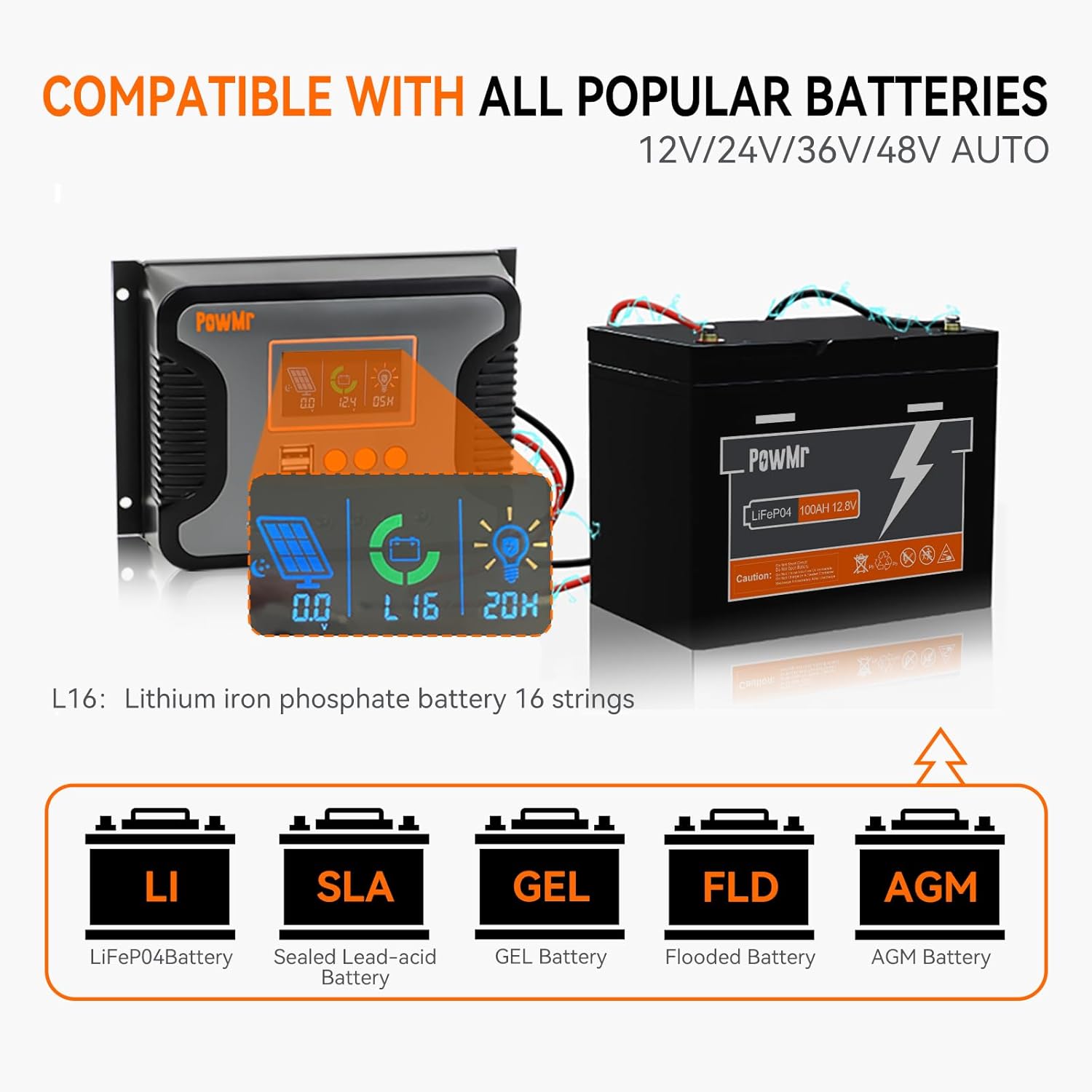
- Dacewar Baturi Mai Faɗi: Compatible with Sealed, LiFePO4, Gel, Flooded, and Lithium batteries.
- Fitar USB Dual: Provides 5V/2.5A (max) for charging mobile devices.
- Kariya da yawa: Includes protection against overheating, short circuits, over-discharging, reverse polarity, and overcurrent.
- Nuni LCD: Real-time monitoring of charging current, generated energy, temperature, and battery voltage.

Hoto na 3.3: Illustration of the controller's compatibility with different battery types, including Lithium Iron Phosphate (LiFePO4), Sealed Lead-Acid (SLA), GEL, Flooded (FLD), and AGM batteries.
Hoto na 3.4: Visual representation of the comprehensive protection features integrated into the controller, ensuring safe operation and longevity of the system components.
4. Bayanan fasaha
| Siffar | Ƙayyadaddun bayanai |
|---|---|
| Samfura | 80 A |
| Tsarin Suna Voltage | 12V/24V/36V/48V Auto |
| Max. PV Input Open Circuit Voltage | 100V |
| Matsakaicin Ƙarfin Shigar da PV (Batir 12V) | 960W |
| Matsakaicin Ƙarfin Shigar da PV (Batir 24V) | 1920W |
| Matsakaicin Ƙarfin Shigar da PV (Batir 36V) | 2880W |
| Matsakaicin Ƙarfin Shigar da PV (Batir 48V) | 3840W |
| Kimanta Cajin Yanzu | 80 A |
| An ƙididdige fitowar DC a halin yanzu | 50 A |
| Fasahar Caji | PWM (3-Stagwa) |
| USB Interface | Dual USB output 5V/2.5A (max) |
| Tsawon Zazzabi Mai Aiki | -20°C ~ +55°C |
| Nauyin Abu | Kilogram 0.7 (kilo 1.54) |
| Nau'in Nuni | LCD |
5. Shigarwa
Proper installation is crucial for the safe and efficient operation of your solar charge controller. Follow these steps carefully:
5.1 Hawan Mai Gudanarwa
- Choose a suitable location: Ensure it is dry, well-ventilated, and protected from direct sunlight and moisture.
- Secure the controller to a wall or mounting surface using four screws.
Fim na 5.1: Quick installation video for PowMr Pstar-80A solar controller. This video demonstrates the physical mounting of the controller and the correct wiring sequence.
5.2 Haɗin Waya
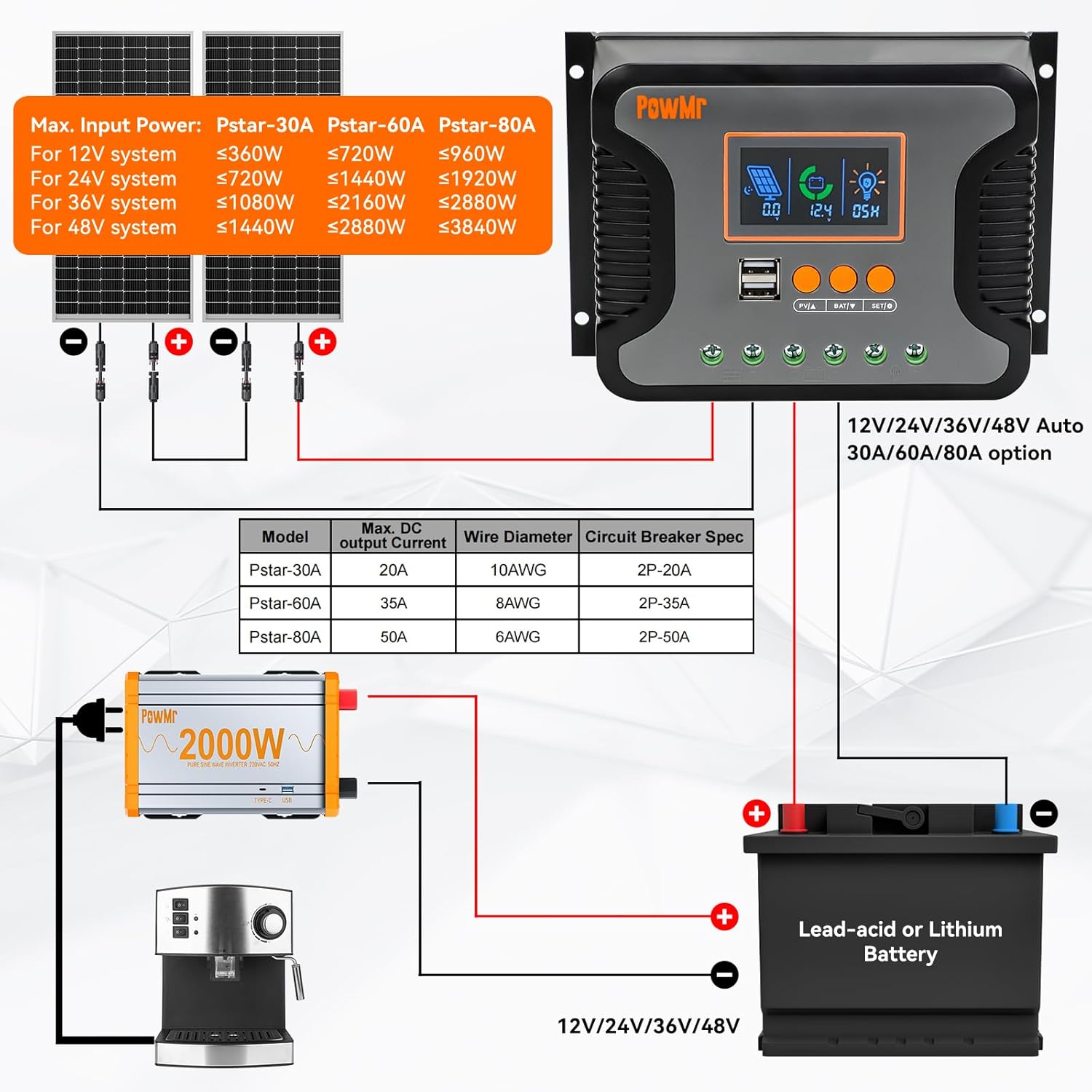
Muhimmi: Always connect the battery first, then the solar panel, and finally the load. Disconnect in the reverse order (load, then solar panel, then battery).
- Haɗa baturi: Connect the positive and negative terminals of your battery to the corresponding battery terminals on the controller. Ensure correct polarity.
- Haɗa Tashoshin Rana: Connect the positive and negative terminals of your solar panel(s) to the corresponding PV input terminals on the controller. Ensure correct polarity.
- Haɗa DC Load (Zaɓi ne): If using a DC load directly from the controller, connect its positive and negative terminals to the load terminals on the controller.
- Kunna Wuta: Rufe na'urar karya batirin don kunna na'urar sarrafawa.

Hoto na 5.1: Comprehensive wiring diagram illustrating the connection points for solar panels, battery, and DC load. It also provides a table with recommended wire diameters and circuit breaker specifications for different models (Pstar-30A, Pstar-60A, Pstar-80A).
Hoto na 5.2: A simplified two-step connection guide, emphasizing the correct sequence of connecting the battery first (Step 1) and then the solar panels (Step 2) to the charge controller.
6. Aiki
The controller features an LCD display and three buttons for easy monitoring and parameter adjustment.
6.1 Nunin LCD da Maɓallai
The LCD displays real-time system information such as solar panel voltage, baturi voltage, charging current, and load status. The three buttons (PV/A, BAT/V, SET/↓) are used for navigating menus and adjusting settings.
- PV/A Button: Short press to cycle through solar panel related displays (e.g., PV voltage, charging current).
- BAT/V Button: Short press to cycle through battery related displays (e.g., battery voltage, battery type).
- SET/↓ Button: Short press to enter or exit setting mode, or to decrease a value during setting. Long press to save settings.
6.2 Saita Nau'in Baturi
To optimize charging, select the correct battery type:
- Danna maɓallin BAT/V button until the battery type icon flashes on the LCD.
- Yi amfani da PV/A kuma SET/↓ buttons to cycle through available battery types (e.g., SEL for Sealed, FLD for Flooded, GEL for Gel, Li for Lithium).
- Once the desired battery type is displayed, long press the SET/↓ maballin don tabbatarwa da adana saitin.
The controller will automatically return to the default display screen if no button is pressed for 100 seconds.
7. Kulawa
Kulawa ta yau da kullun yana tabbatar da tsawon rai da ingantaccen aiki na mai sarrafa cajin hasken rana:
- A riƙa duba duk hanyoyin haɗin waya lokaci-lokaci don ganin ko suna da ƙarfi ko kuma suna da tsatsa.
- Clean the controller's exterior with a dry cloth to remove dust and debris.
- Ensure the ventilation fins are clear of obstructions to allow for proper heat dissipation.
- Kula da allon LCD don ganin duk wani lambobin kuskure ko karatu mara kyau.
8. Shirya matsala
If you encounter issues with your PowMr 80A Solar Charge Controller, refer to the following common problems and solutions:
| Matsala | Dalili mai yiwuwa | Magani |
|---|---|---|
| Mai sarrafawa baya kunnawa | Batirin bai haɗa ba ko kuma ƙaramin voltage; juyi polarity. | Duba haɗin baturi da voltage. Tabbatar da daidaiton daidaito. |
| No charging from solar panels | Solar panels not connected; insufficient sunlight; PV voltage yayi kasa sosai. | Verify solar panel connections. Check for shading. Ensure PV voltage is above battery voltage. |
| Loda ba ya aiki | Load not connected; battery voltage too low; overload protection activated. | Check load connections. Charge battery. Reduce load or check for short circuits. |
| Rashin daidaito voltage karatu | Loose connections; incorrect battery type setting. | Tighten all connections. Verify the correct battery type is selected in settings. |
9. Garanti da Tallafawa
The PowMr 80A Solar Charge Controller comes with a standard manufacturer's warranty. For specific warranty terms, please refer to the warranty card included in your product packaging or contact Temank customer support.
For technical assistance, troubleshooting beyond this manual, or to inquire about replacement parts, please contact Temank customer service through their official webshafin ko bayanin tuntuɓar da aka bayar tare da siyan ku.