1. Gabatarwa
This manual provides instructions for the safe and effective use of the Sealey MM19 Digital Multimeter. The MM19 is a general-purpose multimeter designed for measuring various electrical parameters, including AC and DC voltage, DC current, resistance, audible continuity, and diode/transistor verification. Please read this manual thoroughly before operation and retain it for future reference.
2. Bayanin Tsaro
Always observe basic safety precautions when using electrical test equipment to reduce the risk of fire, electric shock, or personal injury. This device complies with IEC 1010 and CE CAT II safety standards.
- Do not exceed the maximum input limits for any function. Refer to the specifications section for details.
- Kar a taɓa yin amfani da voltage to the meter when the rotary switch is set to Resistance (Ω), Diode, Continuity, or Current (A) functions.
- Yi hankali lokacin aiki tare da voltages sama da 30V AC RMS, 42V kololuwa, ko 60V DC. Waɗannan voltagyana haifar da haɗari.
- Ensure the test leads are in good condition, without cracked or broken insulation.
- Always connect the common (COM) test lead first and disconnect it last.
- Disconnect power to the circuit under test before measuring resistance or continuity.
- Sauya baturin nan da nan when the low battery indicator appears to ensure accurate readings.
3. Samfurin Ya Ƙareview
The Sealey MM19 Digital Multimeter features a clear LCD display, a central rotary switch for function selection, and input jacks for test leads.
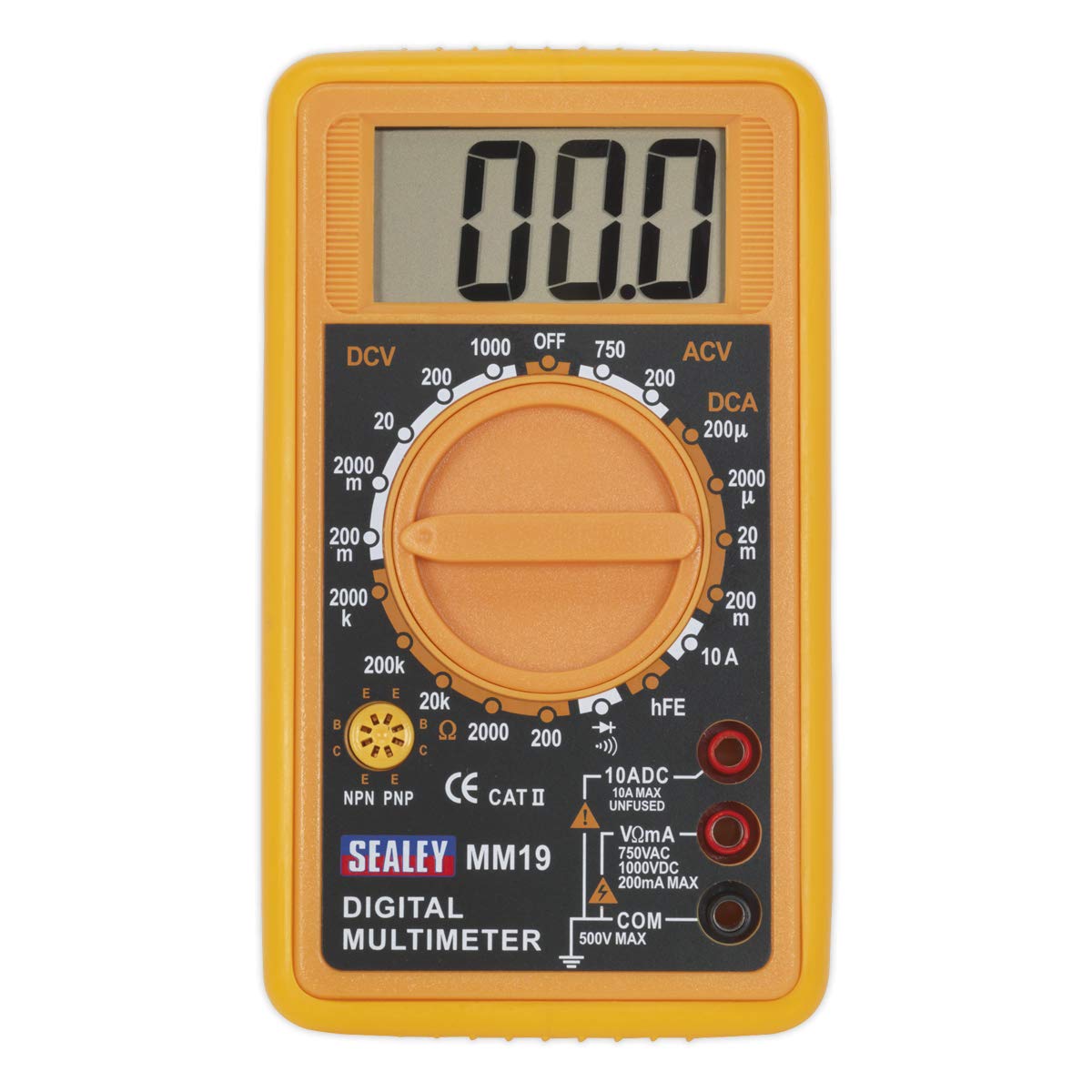
The Sealey MM19 Digital Multimeter, shown with its yellow casing, large LCD display, rotary function switch, and red and black test leads connected to the input jacks.
Abubuwan:
- Nuni LCD: Large (46 x 25mm) digital display for reading measurements.
- Juya Juya: Ana amfani da shi don zaɓar aikin aunawa da kewayon da ake so.
- Jakar Shigarwa ta VΩmA: Za voltage, resistance, and current measurements up to 200mA.
- 10ADC Input Jack: For high current measurements up to 10A DC (unfused).
- COM Shigar Jack: shigarwar gama gari (mara kyau) don duk ma'auni.
- Soket na hFE: For transistor (NPN/PNP) testing.
- Jagoran Gwaji: Red (positive) and Black (negative) leads for connecting to circuits.
4. Saita
4.1. Shigar da Baturi
The Sealey MM19 Multimeter requires a 9V battery for operation. If the display does not illuminate or shows a low battery indicator, the battery needs to be installed or replaced.
- Tabbatar cewa an kashe multimeter ɗin.
- Nemo murfin sashin baturi a bayan naúrar.
- Remove the screw(s) securing the cover and carefully lift it off.
- Connect a new 9V battery to the battery clips, observing correct polarity.
- Sanya baturin a cikin daki kuma maye gurbin murfin, kiyaye shi da dunƙule (s).
4.2. Haɗa Jagoran Gwajin
The multimeter is supplied with a pair of test leads (red and black).
- Saka baki gwajin gubar cikin cikin COM (Common) input jack.
- Don yawancin ma'auni (voltage, resistance, low current), insert the jan gwajin gubar cikin cikin VmA shigar jack.
- For high DC current measurements (up to 10A), insert the jan gwajin gubar cikin cikin 10 ADC shigar jack.
5. Umarnin Aiki
To operate the multimeter, select the desired function and range using the rotary switch.
5.1. Auna DC Voltage (DCV)
- Insert the red lead into the VΩmA jack and the black lead into the COM jack.
- Set the rotary switch to the desired DCV range (e.g., 200m, 2000m, 20, 200, 1000). Start with the highest range if the voltage ba a sani ba.
- Haɗa jagororin gwaji a cikin yanki ko kewaye don aunawa.
- Karanta juzu'intage darajar a kan LCD nuni.
5.2. Aunawa AC Voltage (ACV)
- Insert the red lead into the VΩmA jack and the black lead into the COM jack.
- Set the rotary switch to the desired ACV range (e.g., 200, 750). Start with the highest range if the voltage ba a sani ba.
- Haɗa jagororin gwaji a cikin yanki ko kewaye don aunawa.
- Karanta juzu'intage darajar a kan LCD nuni.
5.3. Auna Wutar Lantarki ta DC (DCA)
- For currents up to 200mA: Insert the red lead into the VΩmA jack and the black lead into the COM jack.
- For currents up to 10A: Insert the red lead into the 10ADC jack and the black lead into the COM jack.
- Set the rotary switch to the desired DCA range (e.g., 200μ, 2000μ, 20m, 200m, 10A). Start with the highest range if the current is unknown.
- Kashe wuta zuwa kewaye. Open the circuit where the current is to be measured.
- Haɗa multimeter a jere tare da da'irar.
- Aiwatar da wutar lantarki zuwa kewaye kuma karanta ƙimar halin yanzu akan nunin LCD.
5.4. Aunawa Juriya (Ω)
- Insert the red lead into the VΩmA jack and the black lead into the COM jack.
- Set the rotary switch to the desired Resistance (Ω) range (e.g., 200, 2000, 20k, 200k, 2000k).
- Tabbatar cewa da'irar da ake gwadawa ba ta da kuzari.
- Haɗa jagorar gwajin a cikin ɓangaren da za a auna.
- Karanta ƙimar juriya akan nunin LCD.
5.5. Gwajin Cigaba Mai Ji
- Insert the red lead into the VΩmA jack and the black lead into the COM jack.
- Set the rotary switch to the continuity symbol (speaker icon).
- Tabbatar cewa da'irar da ake gwadawa ba ta da kuzari.
- Connect the test leads across the component or wire.
- If continuity exists (low resistance), the meter will emit an audible tone. The display will show the resistance value.
5.6. Diode/Transistor Verification Mode (hFE)
- Insert the red lead into the VΩmA jack and the black lead into the COM jack for diode testing.
- Set the rotary switch to the diode symbol.
- Haɗa jajayen jagora zuwa anode da kuma baƙar jagora zuwa cathode na diode. Nunin zai nuna vol na gaba.tage drop. Juya jagorori; allon yakamata ya nuna 'OL' (buɗe madauki) don kyakkyawan diode.
- For transistor hFE measurement, insert the transistor leads (Emitter, Base, Collector) into the appropriate sockets (E, B, C) in the hFE test socket, ensuring correct NPN or PNP type selection.
- Karanta ƙimar hFE akan allon LCD.
6. Kulawa
6.1. Tsaftacewa
Goge mita casing da adamp mayafi da dan wanka mai laushi. Kada a yi amfani da abrasives ko kaushi. Tabbatar cewa mitar ta bushe gaba ɗaya kafin amfani.
6.2. Madadin Baturi
Refer to Section 4.1 for battery installation instructions. Replace the 9V battery when the low battery indicator appears on the display to maintain measurement accuracy.
7. Shirya matsala
- Babu Nuni: Check battery installation and ensure the battery has sufficient charge.
- 'OL' or '1' on Display: This usually indicates an over-range condition or an open circuit. Select a higher range or check connections.
- Karatun da ba daidai ba: Ensure the correct function and range are selected. Check test lead connections and battery condition.
- Babu Sautin Ci gaba: Verify the circuit is de-energized and the leads are making good contact.
8. Ƙayyadaddun bayanai
| Siga | Daraja |
|---|---|
| Alamar | Sealey |
| Lambar Samfura | Saukewa: MM19 |
| Tushen wutar lantarki | Ana Karfin Batir (9V) |
| Nunawa | Digital LCD (46 x 25mm) |
| DC Voltage (DCV) | 200mV, 2000mV, 20V, 200V, 1000V |
| AC Voltage (ACV) | 200V, 750 ku |
| DC Yanzu (DCA) | 200µA, 2000µA, 20mA, 200mA, 10A |
| Tsayayya (Ω) | 200Ω, 2000Ω, 20kΩ, 200kΩ, 2000kΩ |
| Ci gaba | Audible tone below approx. 30Ω |
| Gwajin Diode | Gabatarwa voltage drop display |
| Gwajin transistor | hFE (NPN/PNP) |
| Ƙimar Tsaro | CE CAT II, IEC 1010 |
| Girma (L x W x H) | 1.93 x 4.21 x 6.06 inci |
| Nauyin Abu | 9.5 oganci (0.27 Kilogram) |
9. Garanti da Tallafawa
For warranty information or technical support, please refer to the documentation provided with your purchase or contact Sealey customer service directly. Keep your proof of purchase for any warranty claims.


