1. Gabatarwa
The POWERTECH MP3752 is an intelligent and lightweight solar charge controller designed to manage the power flow from your solar panels to your battery bank. Utilizing Pulse Width Modulation (PWM) technology, it ensures efficient and safe battery charging. This controller offers a set-and-forget operation, providing maximum charge into your batteries without constant monitoring. It integrates essential safety features such as overload, short-circuit, over-discharge, and reverse-polarity protection. Additionally, a convenient USB port on the front panel allows for up to 1.2A charging, useful for mobile devices during power outages. The unit supports various battery types including sealed lead-acid, Gel, and flooded cells, and automatically selects the optimal charging mode (bulk, equalise, float).
2. Bayanin Tsaro
Please read all instructions carefully before installation and operation. Failure to follow these instructions may result in damage to the unit, battery, or personal injury.
- Tabbatar cewa duk hanyoyin haɗin suna daidai kuma an tsare su kafin amfani da wutar lantarki.
- Do not connect the solar controller to an AC power source.
- Sanya na'urar sarrafawa a wuri mai iska mai kyau, nesa da kayan da za su iya kama da wuta da kuma hasken rana kai tsaye.
- A guji rage wutar lantarki a tashoshin batirin ko kuma tashoshin hasken rana.
- Kullum a haɗa batirin da farko, sannan a haɗa na'urar hasken rana, sannan a ƙarshe a haɗa kayan. A cire haɗin a bi da bi.
- This device is not waterproof; protect it from moisture and water.
- ƙwararrun ma'aikata ne kawai yakamata suyi shigarwa da kulawa.
3. Kayan Samfura
- Automatic charge mode selection (Bulk, Equalise, Float).
- Suitable for both 12V and 24V battery banks.
- Integrated USB charging port (5V, 1.2A max) on the front panel.
- Supports sealed lead-acid, Gel, and flooded battery types.
- Comprehensive protection features: overload, short-circuit, over-discharge, reverse-polarity.
- Pulse Width Modulation (PWM) charging technology.
4. Abubuwan Kunshin
Da fatan za a duba abubuwan da ke cikin kunshin bayan an karɓa:
- 1 x POWERTECH MP3752 Solar Controller
- 1 x Manual mai amfani (wannan takarda)
5. Samfurin Ya Ƙareview da Connections
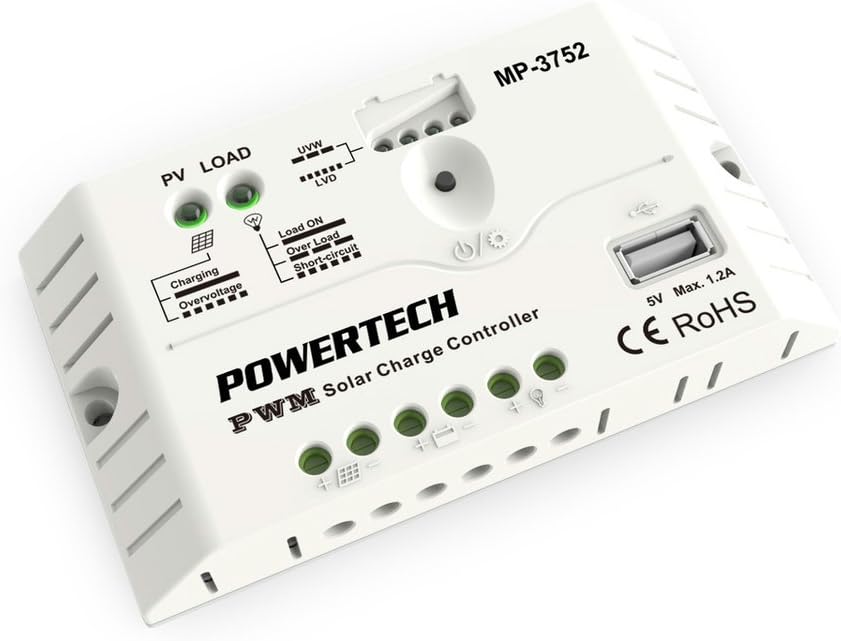
Hoto 1: Gaba view of the POWERTECH MP3752 Solar Controller. This image displays the PV LOAD, UVW, LVD, Load ON, Over Load, Short-Circuit indicators, the USB port, and the connection terminals for solar panels, battery, and load.
The MP3752 controller features clearly marked terminals for easy connection. Refer to Figure 1 for a visual guide to the controller's layout and indicators.
Tashar haɗi:
- Solar Panel Input (PV): Connect your solar panel array here. Ensure correct polarity (+ and -).
- Haɗin baturi: Connect your 12V or 24V battery bank here. Observe correct polarity (+ and -).
- Load Output: Connect your DC loads (e.g., lights, fans) here. Observe correct polarity (+ and -).
- Tashar USB: 5V, 1.2A max output for charging small electronic devices.
6. Saita da Shigarwa
Bi waɗannan matakan don shigar da na'urar sarrafa wutar lantarki ta hasken rana yadda ya kamata:
- hawa: Choose a dry, well-ventilated indoor location, away from direct sunlight, high temperatures, and moisture. Ensure sufficient air circulation around the controller.
- Haɗin baturi:
- Connect the positive (+) terminal of the battery to the battery positive (+) terminal on the controller.
- Connect the negative (-) terminal of the battery to the battery negative (-) terminal on the controller.
- The controller will automatically detect if it's a 12V or 24V system.
- Haɗin Tashoshin Rana:
- Connect the positive (+) terminal of the solar panel to the solar panel positive (+) terminal on the controller.
- Connect the negative (-) terminal of the solar panel to the solar panel negative (-) terminal on the controller.
- Ensure the open-circuit voltage of the solar panel does not exceed the maximum input voltage of the controller (typically 50V for 12/24V systems).
- Haɗin Load:
- Connect the positive (+) terminal of your DC load to the load positive (+) terminal on the controller.
- Connect the negative (-) terminal of your DC load to the load negative (-) terminal on the controller.
- Do not exceed the maximum rated current for the load output (20A).
- Tabbatar da Haɗin kai: Double-check all connections for correct polarity and tightness before proceeding.

Figure 2: The POWERTECH MP3752 Solar Controller shown in its packaging, illustrating its application with solar panels. This image provides a contextual view of the product's intended use.
7. Umarnin Aiki
7.1. Automatic System Voltage Ganewa
The controller automatically detects whether the connected battery bank is 12V or 24V upon initial connection. Ensure the battery is connected first for proper voltage ganewa.
7.2. Hanyoyin Caji
The MP3752 employs intelligent PWM charging, automatically cycling through different stages to optimize battery health and lifespan:
- Babban Caji: Delivers maximum current to rapidly bring the battery to approximately 80% charge.
- Equalise Charge: Periodically applies a higher voltage to equalize the charge among battery cells, preventing sulfation and extending battery life (for flooded batteries).
- Jirgin Jirgin Ruwa: Maintains the battery at a full charge by providing a small, constant voltage, compensating for self-discharge.
7.3. Load Control
The load output is controlled by the controller to prevent over-discharge of the battery. When the battery voltage ya faɗi ƙasa da Low Voltage Disconnect (LVD) threshold, the load output will be automatically disconnected. It will reconnect once the battery has recharged to the Low Voltage Reconnect (LVR) threshold.
Press the power button on the controller to manually turn the load output ON or OFF.
7.4. Tashar caji ta USB
The 5V, 1.2A USB port can be used to charge small electronic devices like smartphones or tablets. This port is active as long as the battery has sufficient charge.
8. Manuniya
The POWERTECH MP3752 features several LED indicators to provide real-time status information:
- PV LOAD (Solar Panel Indicator):
- Kore: Solar panel is connected and generating power.
- A kashe: No solar input or insufficient light.
- Alamar Caji:
- Kore: Baturi yana caji
- A kashe: Battery is fully charged or not charging.
- Ƙarfafawatage Nuni:
- Ja: Shigar da kunditage from solar panel is too high, or battery voltage is overcharge protection level.
- UVW (Battery Voltage Indicator): Multiple LEDs indicating battery charge level.
- LVD (Low Voltage Disconnect Indicator):
- Ja: Baturi voltage is low, load output has been disconnected.
- Load ON Indicator:
- Kore: Load output is active.
- Over Load Indicator:
- Ja: Load current exceeds the maximum rated current. Load output may be temporarily disconnected.
- Short-Circuit Indicator:
- Ja: Short-circuit detected on the load output. Load output will be disconnected.
9. Kulawa
Domin tabbatar da ingantaccen aiki da tsawon rai na na'urar sarrafa cajin hasken rana, ana ba da shawarar a riƙa kulawa akai-akai:
- Tsaftacewa: Periodically clean the exterior of the controller with a dry, soft cloth. Do not use solvents or abrasive cleaners.
- Haɗin kai: Annually check all wiring connections for tightness and corrosion. Loose connections can cause overheating and poor performance.
- Samun iska: Ensure that the ventilation openings are not blocked and that there is adequate airflow around the unit.
- Dubawa: Inspect the controller for any signs of physical damage, discoloration, or unusual odors.
10. Shirya matsala
| Matsala | Dalili mai yiwuwa | Magani |
|---|---|---|
| No charging from solar panel. |
|
|
| Load output not working. |
|
|
| Ƙarfafawatage nuna alama yana kunne. |
|
|
11. Ƙayyadaddun bayanai
| Siga | Daraja |
|---|---|
| Lambar Samfura | MP3752 (03617080) |
| Tsarin Voltage | 12V/24V Auto-sensing |
| Max. Cajin Yanzu | 20 A |
| Max. Load Yanzu | 20 A |
| Fitar USB | 5V, 1.2A Max |
| Nau'in Caji | PWM (Bulk, Equalise, Float) |
| Nau'in Baturi Ana Tallafawa | Sealed Lead-Acid, Gel, Flooded |
| Girman samfur | 5.83 x 3.39 x 1.38 inci |
| Nauyin Abu | 5.6 oz |
| Mai ƙira | POWERTECH |
| Alamar | Jaycar |
12. Garanti da Tallafawa
This product is covered by a standard manufacturer's warranty against defects in materials and workmanship. Please refer to your purchase documentation for specific warranty terms and duration. For technical support, troubleshooting assistance, or warranty claims, please contact your retailer or the manufacturer directly.
Note: Unauthorized disassembly or modification of the product will void the warranty.


