1. Bayanin Tsaro
Please read and understand all safety information and operating instructions before using this multimeter. Failure to follow these instructions may result in electric shock, fire, or damage to the meter.
- Always ensure the test leads are properly connected and the function switch is set to the correct range before making any measurements.
- Kada kayi ƙoƙarin auna juzu'itages or currents exceeding the maximum rated values for this meter.
- Yi taka tsantsan yayin aiki tare da da'irori kai tsaye. Babban voltages na iya zama haɗari.
- Never open the meter casing unless specifically instructed for battery or fuse replacement. Ensure test leads are disconnected before opening.
- Sauya baturin lokacin da ƙaramin baturi ya bayyana don tabbatar da ingantaccen karatu.
- Kada a yi amfani da mitar idan ya bayyana ya lalace ko kuma idan an lalata rufin kan hanyoyin gwajin.
Hoto na 1: Na baya view of the Rebel MIE-RB-830 Multimeter, showing the battery compartment cover and a warning label. The label advises removing test leads before opening the case to avoid electrical shock and to install fuses with correct amp/volt ratings. It also indicates the power supply is a 9V battery, type NEDA 1604 9V 6F22.
2. Samfurin Ya Ƙareview
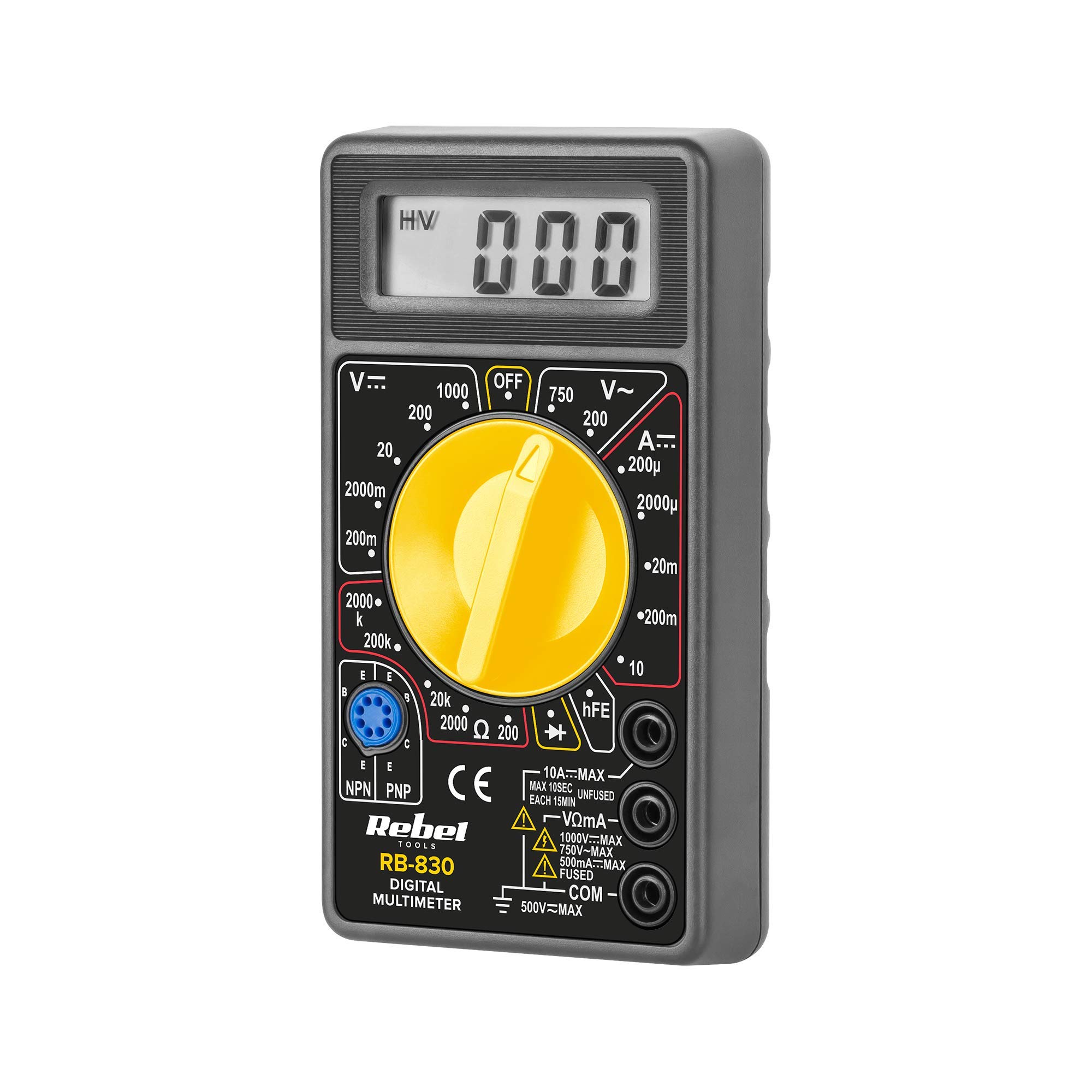
The Rebel MIE-RB-830 is a compact, battery-operated digital multimeter designed for measuring DC/AC voltage, DC current, resistance, diode, and transistor (hFE) values. It is suitable for general electrical testing and troubleshooting.
2.1. Aka gyara
- Digital Multimeter Unit
- Gwajin Gubar (Ja da Baki)
- 9V Battery (may be included or sold separately)
- Jagorar mai amfani (wannan takaddar)

Hoto na 2: The Rebel MIE-RB-830 Digital Multimeter shown with its accompanying red and black test leads. The multimeter features a large LCD display and a rotary function switch.

Hoto na 3: Kusa view of the red and black test leads. These leads are essential for connecting the multimeter to the circuit under test.
3. Saita
3.1. Shigar da Baturi
- Ensure the multimeter is turned OFF and all test leads are disconnected.
- Locate the battery compartment cover on the back of the meter (refer to Figure 1).
- Unscrew the retaining screw(s) and carefully remove the cover.
- Insert a new 9V battery (NEDA 1604 or 6F22 type), observing the correct polarity (+ and -).
- Maye gurbin murfin batir kuma amintar da shi tare da dunƙule (s).
3.2. Haɗa Jagoran Gwajin
- Haɗa da ja test lead to the "VΩmA" input jack.
- Haɗa da baki test lead to the "COM" (common) input jack.
- For current measurements exceeding 200mA (up to 10A), connect the red test lead to the "10A" input jack.
4. Umarnin Aiki
4.1. Zaɓin Aiki
Turn the rotary switch to the desired measurement function and range. Always start with a higher range if the approximate value is unknown to prevent overloading the meter.
4.2. Auna DC Voltage (V–)
- Saita maɓallin juyawa zuwa DC Vol da ake sotage (V–) range (e.g., 20V, 200V).
- Haɗa jajayen gwajin zuwa gefen tabbatacce (+) na da'irar da kuma baƙiyen gwajin zuwa gefen korau (-).
- Karanta juzu'intage darajar a kan LCD nuni.
4.3. Aunawa AC Voltage (V∼)
- Saita maɓallin juyawa zuwa Vol ɗin AC da ake sotage (V∼) range (e.g., 200V, 750V).
- Haɗa jagororin gwaji a fadin ƙarfin ACtage tushen.
- Karanta juzu'intage darajar a kan LCD nuni.
4.4. Measuring DC Current (A–)
Tsanaki: To measure current, the meter must be connected in series with the circuit. Never connect the meter in parallel with a voltage source when in current mode, as this can damage the meter and the circuit.
- Set the rotary switch to the desired DC Current (A–) range (e.g., 20mA, 200mA, 10A).
- For currents up to 200mA, ensure the red lead is in the "VΩmA" jack. For currents up to 10A, move the red lead to the "10A" jack.
- Bude kewaye inda za a auna halin yanzu kuma haɗa mita a jere.
- Karanta darajar yanzu akan nunin LCD.
4.5. Measuring Resistance (Ω)
Tsanaki: Ensure the circuit or component under test is de-energized before measuring resistance.
- Set the rotary switch to the desired Resistance (Ω) range (e.g., 200Ω, 2kΩ, 200kΩ).
- Haɗa jagororin gwaji a cikin yanki ko kewaye don aunawa.
- Karanta ƙimar juriya akan nunin LCD.
4.6. Diode Test (→|–)
- Set the rotary switch to the Diode Test (→|–) position.
- Connect the red test lead to the anode of the diode and the black test lead to the cathode.
- Nuni zai nuna gaba voltage drop (typically 0.5V to 0.8V for silicon diodes).
- Reverse the leads. The display should show "OL" (Open Loop) for a good diode.
4.7. Transistor (hFE) Test
- Saita jujjuyawar juyawa zuwa matsayin hFE.
- Gano ko transistor ɗin shine NPN ko PNP.
- Insert the transistor's emitter, base, and collector leads into the corresponding sockets on the hFE test socket.
- Read the hFE (DC current gain) value on the display.
5. Kulawa
5.1. Madadin Baturi
When the low battery indicator appears on the display, replace the 9V battery as described in Section 3.1. Using a low battery can lead to inaccurate readings.
5.2. Sauya Fuse
If the current measurement function stops working, the fuse may need replacement. This operation should only be performed by qualified personnel.
- Ensure the multimeter is turned OFF and all test leads are disconnected.
- Open the back casing of the meter (this may involve more screws than just the battery compartment).
- Locate the blown fuse and replace it with a fuse of the exact same type and rating (e.g., F200mA/250V for mA range, F10A/250V for 10A range). Refer to the internal markings or specifications for precise fuse ratings.
- Carefully reassemble the meter, ensuring all screws are tightened.
5.3. Tsaftacewa
Goge mita tare da tallaamp cloth and mild detergent. Do not use abrasives or solvents. Keep the meter dry.
6. Shirya matsala
| Matsala | Dalili mai yiwuwa | Magani |
|---|---|---|
| Babu nuni ko shuɗewar nuni | Low ko mataccen baturi | Sauya batirin 9V. |
| Karatun da ba daidai ba | Low battery; Incorrect range selection; Poor test lead connection | Replace battery; Select appropriate range; Ensure leads are firmly connected. |
| Ma'aunin yanzu baya aiki | Blown fuse; Incorrect lead connection for current | Replace fuse (see Section 5.2); Ensure red lead is in "VΩmA" or "10A" jack as appropriate. |
| "OL" (Overload) yana nunawa | Measured value exceeds selected range; Open circuit (for resistance/continuity) | Select a higher range; Check circuit for breaks. |
7. Ƙayyadaddun bayanai
| Aikin Aiki | Rage | Daidaito |
|---|---|---|
| DC Voltage (V–) | 200mV, 2V, 20V, 200V, 1000V | ± (0.5% + 2 lambobi) |
| AC Voltage (V∼) | 200V, 750 ku | ± (1.2% + 10 lambobi) |
| DC Current (A–) | 200µA, 2mA, 20mA, 200mA, 10A | ± (1.0% + 2 lambobi) |
| Resistance (Ω) | 200Ω, 2kΩ, 20kΩ, 200kΩ, 2MΩ | ± (0.8% + 2 lambobi) |
| Gwajin Diode | Ee | Gabatarwa voltagda drop |
| Gwajin transistor (hFE). | Ee | hFE value |
| Tushen wutan lantarki | 9V Battery (NEDA 1604 or 6F22) | |
| Nunawa | 3½ Digit LCD, Max. 1999 | |
| Girma | Kimanin. 13.5 x 10 x 4 cm | |
| Nauyi | Approx. 107 grams (without battery) | |
| Yanayin Aiki | 0°C zuwa 40°C (32°F zuwa 104°F) | |
| Ajiya Zazzabi | -10°C zuwa 50°C (14°F zuwa 122°F) | |
| Matsayin Tsaro | CE, RoHS |
8. Garanti da Tallafawa
This Rebel MIE-RB-830 Digital Multimeter is covered by a standard manufacturer's warranty against defects in materials and workmanship. Please refer to the warranty card included with your purchase or contact your retailer for specific warranty terms and conditions.
For technical support or service inquiries, please contact the point of purchase or visit the official Rebel website don bayanin lamba.


