1. Gabatarwa
Thank you for choosing the EazeID D210S Label Maker. This portable device is designed for efficient and versatile labeling, suitable for various environments including home, office, and school. Featuring a user-friendly QWERTY keyboard and dual power options, it produces durable, laminated labels resistant to water, abrasion, fading, and temperature changes.
This manual provides detailed instructions on how to set up, operate, and maintain your label maker to ensure optimal performance and longevity.
2. Saita
2.1. Abubuwan Kunshin
Kafin ka fara, da fatan za a tabbatar cewa duk abubuwa suna nan a cikin kunshin ku:
- EazeID D210S Gray label maker (1 unit)
- Sample label tape waterproof (12mm 0.47 laminated White, 4M) (1 unit)
- Type-C Cable (1 unit)
- Littafin mai amfani (raka'a 1)

Image: Contents of the EazeID D210S Label Maker package, including the device, sample tape, Type-C cable, and manual.
2.2. Ƙarfafa Na'urar
The EazeID D210S label maker offers two power options:
- Kebul na Type-C: Connect the included Type-C cable to the label maker and a compatible power adapter (not included). The device does not support charging via Type-C; it operates directly from the power source.
- Batirin AAA: For portable use, insert 6 AAA batteries (not included) into the battery compartment located on the underside of the device. Ensure correct polarity.
Lura:
- It is recommended to use a charger block with an output voltage of ±5V when using the Type-C cable.
- Do not leave batteries in the printer when it is powered by the USB Type-C cable.

Image: Illustration of the label maker's dual power options: USB Type-C for continuous power and AAA batteries for portability.
2.3. Installing Label Tape
To install the label tape:
- Open the tape compartment cover on the back of the label maker.
- Insert the label tape cassette with the tape facing the print head. Ensure the tape is properly aligned and clicks into place.
- Close the tape compartment cover securely.
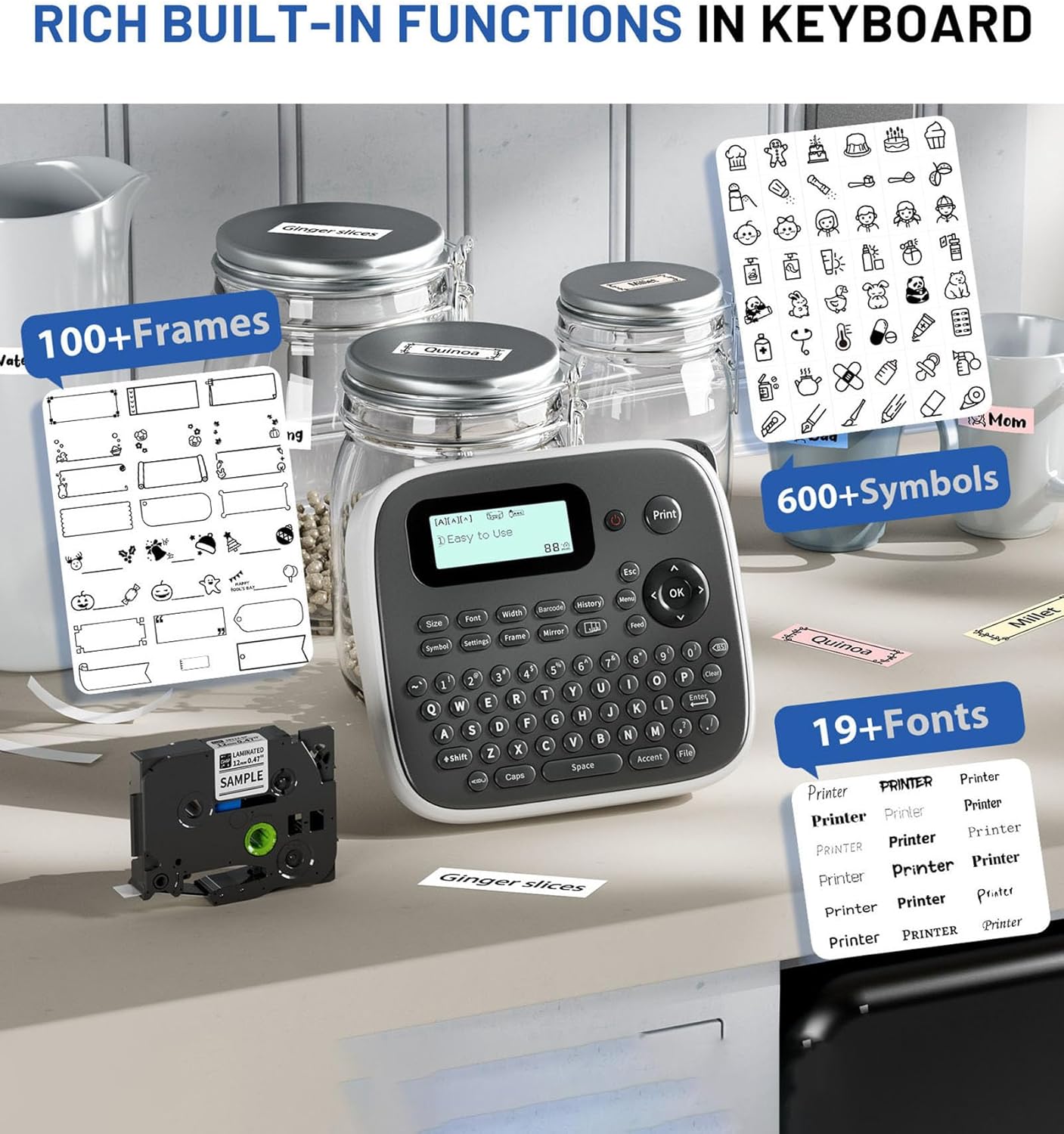
Image: The label maker with its tape compartment open, illustrating the tape installation area and the integrated cutter.
3. Umarnin Aiki
3.1. Basic Label Creation
Follow these steps to create a basic label:
- Kunna Wuta: Danna maɓallin wuta don kunna mai yin lakabin.
- Shigar da Allon madannai: Use the QWERTY keyboard to type your desired text. The text will appear on the LCD screen.
- Buga: Danna maɓallin Buga button to print the label.

Image: A visual guide demonstrating the simple three-step process to operate the label maker.
3.2. Text Formatting and Special Functions
The D210S label maker includes a variety of built-in functions to customize your labels:
- Salon Font: Access 16 font styles using the dedicated Font key.
- Alamomi: Choose from over 640 symbols using the Alama key.
- Frames: Apply over 100 frames to your labels using the Frame key.
- Sauran Ayyuka: Utilize keys for Size, Width, Barcode, History, Mirror, and more for advanced customization.

Image: The label maker showcasing its extensive library of frames, symbols, and font options for creative labeling.
3.3. Printing Multiple Labels
The D210S offers efficient options for printing multiple labels:
- Multi-Copy Editing: Use the multi-copy editing one-touch key to continuously edit and print up to 55 different labels. This is ideal for creating a series of unique labels without re-entering the menu.
- Printing Identical Labels: To print multiple copies of the same label, it is advisable to print them all at once and then cut them individually. You can specify the number of copies (1-9) by pressing Shift + Buga, then using the navigation keys or a number key, and finally pressing OK or Buga.

Image: A flowchart demonstrating how to use the multi-copy function for sequential label printing.

Image: A guide on how to efficiently print multiple identical labels using the Shift + Print key combination.
3.4. Clearing Text
To clear text or formatting:
- Delete Letters One by One: Danna maɓallin BS (Backspace) key.
- Delete All Text and Format: Latsa Share → OK → [Text & Format] → OK.
- Delete Text Only: Latsa Share → [Rubutu Kawai] → OK.

Image: A step-by-step guide on using the Clear function to remove text or formatting from the label maker's display.
3.5. Using the Built-in Cutter
After printing, use the integrated cutter to cleanly separate your label from the tape roll. The cutter is located on the side of the device. Press the cutter lever firmly to cut the label.
3.6. Optimizing Label Tape Usage
To reduce label tape costs, it is recommended to set the label margin to "Narrow" in the device settings. Navigate to Saituna → Margin → kunkuntar.
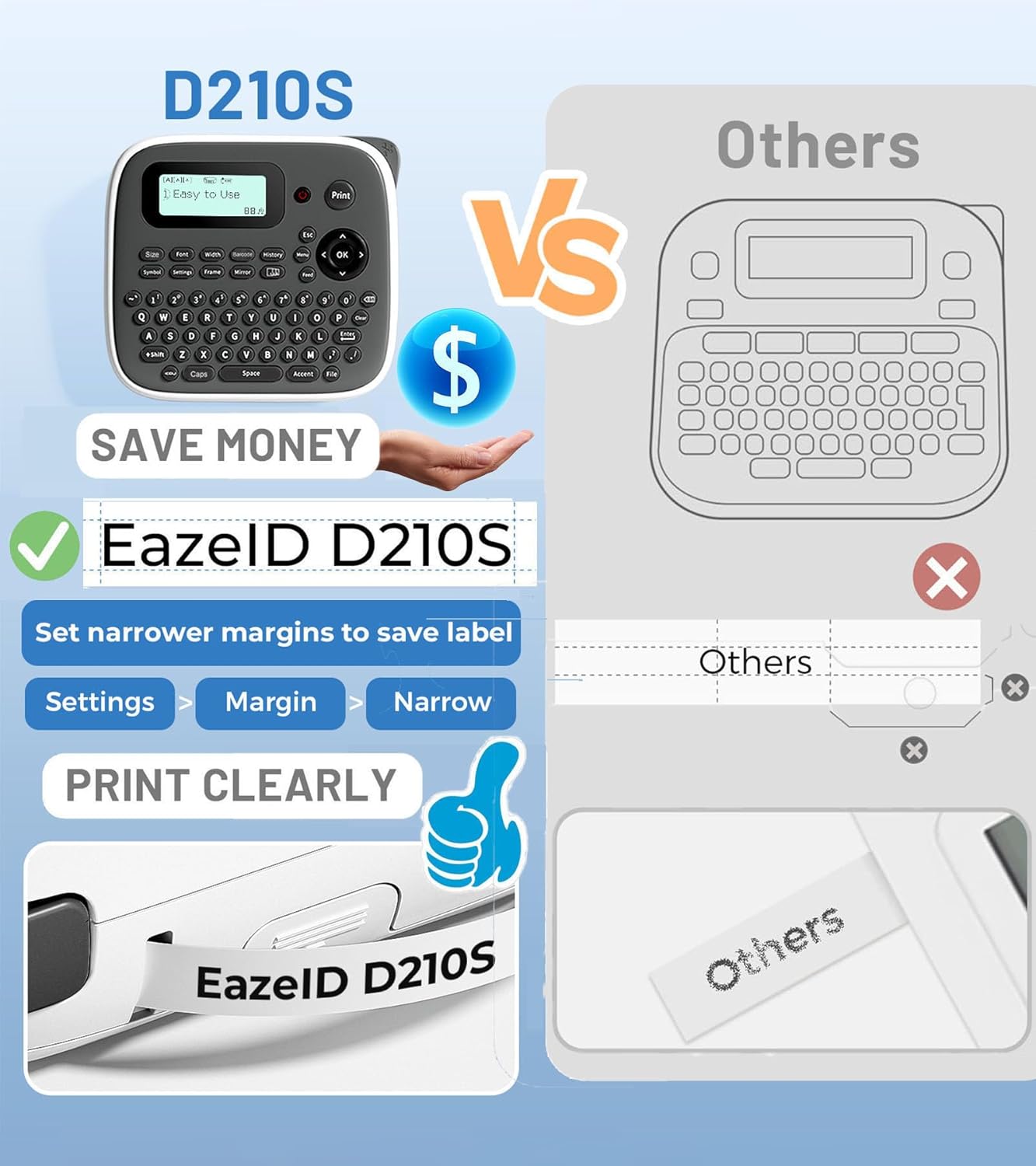
Image: A visual comparison highlighting the tape-saving benefit of using the 'Narrow' margin setting on the D210S.
4. Kulawa
4.1. Tsaftacewa
To ensure optimal performance and print quality, regularly clean your label maker:
- Goge wajen na'urar da kyalle mai laushi da busasshe.
- If the print head becomes dirty, gently wipe it with a cotton swab dampened with isopropyl alcohol. Ensure the device is turned off and disconnected from power before cleaning.
- Remove any dust or debris from the tape compartment.
4.2. Tape Replacement
When the label tape runs out or you wish to change tape types, follow the tape installation instructions in Section 2.3. Ensure you use compatible EazeID D210S label tapes for best results.
4.3. Adana
Store the label maker in a cool, dry place away from direct sunlight and extreme temperatures. If storing for an extended period, remove the AAA batteries to prevent leakage.
5. Shirya matsala
If you encounter issues with your EazeID D210S Label Maker, refer to the following common problems and solutions:
| Matsala | Dalili mai yiwuwa | Magani |
|---|---|---|
| Na'urar baya kunnawa | Low or dead batteries; USB cable not connected properly; incorrect power adapter. | Replace AAA batteries; ensure USB Type-C cable is securely connected; use a compatible 5V power adapter. |
| Poor print quality (faint, blurry, or missing lines) | Dirty print head; incorrect tape installation; low tape quality. | Clean the print head (see Section 4.1); re-install label tape correctly; ensure you are using genuine EazeID D210S compatible tape. |
| Tape jams frequently | Improper tape installation; foreign objects in tape path; tape not feeding smoothly. | Re-install tape, ensuring it is seated correctly; check for and remove any obstructions; ensure tape is not creased or damaged. |
| Label not cutting properly | Cutter blade dull or obstructed. | Ensure no tape residue is blocking the cutter; if issues persist, contact customer support. |
| Saƙon kuskure akan allo | Specific error condition. | Refer to the on-screen message for guidance. Common errors relate to tape issues (e.g., "Tape End"). Follow instructions or re-install tape. |
6. Ƙayyadaddun bayanai
| Sunan Samfura | D210S Gray Label Maker Machine |
| Alamar | EzeID |
| Fasahar Bugawa | Thermal |
| Fasahar Haɗuwa | Allon madannai |
| Matsakaicin Girman Mai jarida | 12mm ku |
| Matsakaicin Matsakaicin Buga Launi | 180 DPI |
| Matsakaicin Baƙi da Farin Ƙimar Buga | 203 DPI |
| Tushen wutan lantarki | Type-C Cable or 6 AAA Batteries |
| Girman samfur | 5 x 5 x 2 inci |
| Nauyin Abu | 1.26 fam |
| Abubuwan da aka haɗa | Label maker, Sample label tape, Type-C Cable, User Manual |
| Maximum Copies Per Run | 55 (different labels) |
7. Garanti da Tallafawa
7.1. Garanti Bayani
The EazeID D210S Label Maker comes with a limited warranty. Please refer to the warranty card included in your package or visit the official EazeID webshafin don cikakkun sharuɗɗa da sharuɗɗa game da garanti da tsawon lokaci.
7.2. Tallafin Abokin Ciniki
For technical assistance, troubleshooting not covered in this manual, or inquiries about replacement parts and accessories, please contact EazeID customer support. Contact information can typically be found on the EazeID official website ko a kan marufi na samfur.
8. Bidiyon Samfura
Ba a sami bidiyon samfurin hukuma daga mai siyar ba a cikin bayanan da aka bayar don sakawa a cikin wannan jagorar.


